
Every input into the uranium bull case is now sitting at, or near, an all-time high. Production costs are at a record. Long-term contract prices are at a record. Enrichment prices are at a record. And yet the equities tied to all of that — the miners, the developers, the explorers — spent July getting crushed.
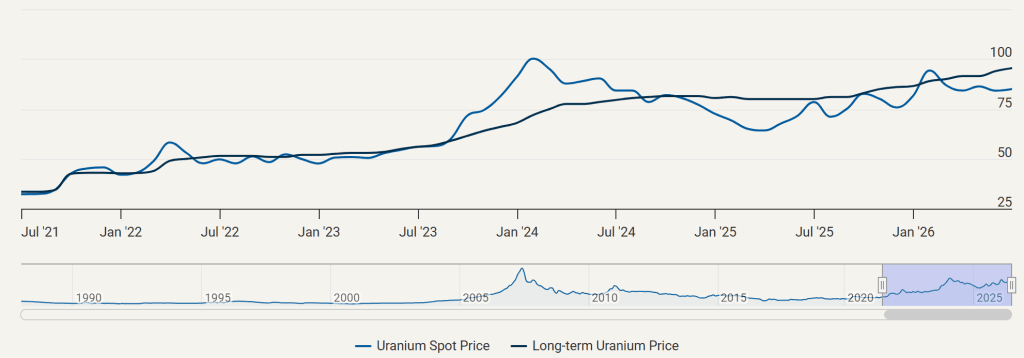
This disconnect between true demand, and purchases is the opportunity facing any producer why can get production online by the end of the decade. s the whole story right now, and it’s the lens through which US-based, near-term producers like Anfield Energy (NASDAQ:AEC, TSXV:AEC), Uranium Energy Corp (NYSE American: UEC), Ur-Energy Inc. (NYSE American: URG / TSX: URE), Energy Fuels (NYSE American: UUUU) and enCore Energy Corp (NASDAQ: EU / TSXV: EU) need to be evaluated.
Rising Costs Signal a Higher Floor for Uranium
TradeTech’s latest Production Cost Indicator — the weighted-average global cost of getting a pound of U3O8 out of the ground before a producer earns any margin — closed July at an all-time high of $62.90/lb. Alongside it, spot U3O8 rose $1.25 to $86.50, while the long-term price held at its own record of $97/lb.
A rising cost floor means the price at which new supply actually clears the market keeps ratcheting higher, and it’s happening at the same time utilities are still under-bought relative to what they’ll eventually need to burn.
The Buyers Aren’t Buying at Replacement Rate — And That’s a Bullish Signal
What’s happening this cycle from buyers, may be tripping up newer uranium investors. Utility contracting volume — the actual long-term pounds utilities sign up for each year — has been running well below the roughly 150 million lb/year replacement rate the market needs just to meet regular operations, let alone supply the new reactors coming online. Coming out of 2025, cumulative long-term contracting had reached only about 75 million lbs, roughly half of replacement, after a year defined by policy uncertainty and utilities’ willingness to simply defer.
That may sounds like weak demand, but in reality its simply deferred demand. The reactors need to keep running, so they will need this uranium sooner or later. Utility buyers have chosen to let stockpiles draw down hoping they can catch up on their buying quotas at lower prices in the future. The buyer’s ability to sit on their hands is limited though and the longer they wait, the risk grows they will have to panic buy at any price as has happened in prior cycles.
Uranium investor Sprott’s own uranium desk has made this point directly: producers are done selling into weakness, utilities are running out of room to keep waiting, and “the stalemate that we’ve seen is eventually going to break.”
Cameco’s second-quarter 2026 results, released in the past few weeks, provide useful color. Realized uranium prices rose 15% year-over-year to $93.13/lb even as production came in lower on weather-related disruptions at Key Lake, MacArthur River and Cigar Lake. Management described market-related contracts now carrying price floors in the high $70s and ceilings near $160 — both escalated — and said contracting activity continued to improve through the quarter even though the market remains short of replacement-rate volume.
Cameco raised its full-year realized-price guidance on the back of it. That is a Tier 1 producer telling you, in the driest language available to a public company, that the floor under this market keeps rising even in a quarter with messy operational headlines.
Meanwhile the paper market has been telling the opposite story. $URNM closed out its worst July on record in July 2026, compounding the worst May and worst March of the year — all after an extraordinary January that saw spot prices punch through $100/lb intraday for the first time since 2007. Every month like that, as one uranium-focused investor we spoke with put it, “pushes the beach ball deeper under water.” Producers, developers and explorers were broadly down 40–50% from 52-week highs by mid-year, even with spot still elevated versus where it traded a year ago.
That gap — record fundamentals, beaten-down equities — is a classic feature of the early-to-middle innings of a commodity cycle, not the late innings. Late-cycle blow-offs are characterized by euphoric buying chasing a price that’s already run; what the sector is showing instead is capitulation in the paper alongside quiet strength in the physical and contract markets.
Sprott Physical Uranium Trust added another 100,000 lbs to its holdings in early August, taking advantage of a roughly 10% discount to NAV even with its trust sitting on $93.2 million of cash still to deploy. The fund with a mandate to buy physical pounds, doing exactly that, at a discount, while sentiment is beaten down.
Washington Has Picked a Side
Policy reinforces the same read. The Department of Energy spent early 2026 rebuilding a domestic fuel cycle that doesn’t run through Moscow. In January, DOE awarded a combined $2.7 billion in task orders to three companies, American Centrifuge Operating (Centrus), General Matter, and Orano Federal Services, to expand domestic LEU and HALEU enrichment capacity ahead of the 2028 ban on Russian enriched uranium imports. Congress has separately funded a national uranium reserve, and utilities on both the sovereign and commercial side are increasingly framing purchases around supply security rather than price alone, per Cameco’s own commentary on its customer base.
That federal posture reaches down to the mine level too, not just enrichment. The Department of the Interior’s emergency permitting procedures, built to compress environmental review from years down to as little as 14 days for priority energy projects, have already been used once on a uranium mine. It is probably not a coincidence that the beneficiary was tied to the company at the center of this note.
Investing in Near Term Production Seems Like the Lowest Risk Strategy in This Market
If the macro argument is that the US needs domestic uranium supply and needs it soon, Anfield Energy is one of the few companies actually positioned to deliver both a mine and a mill inside the current cycle.
The centerpiece of Anfield’s story is the Shootaring Canyon Mill in Garfield County, Utah — one of only three conventional uranium mills ever licensed, permitted and constructed in the United States. Built in 1980, it ran for six months in 1982, produced 27,825 lbs of concentrate, and then sat idle for more than four decades as uranium prices collapsed.
Anfield picked up the asset from Uranium One in 2015 and has spent the past several years positioning it as the central processing hub for a network of satellite uranium-vanadium mines across Utah and Colorado — a “hub-and-spoke” model that lets Anfield bring multiple smaller deposits into one centralized mill rather than building standalone processing at each site.
The past six months of press releases tell a clean, sequential story of a restart actually being executed rather than merely promised:
In May, Anfield filed an updated Preliminary Economic Assessment combining Shootaring with its Velvet-Wood, Slick Rock and West Slope tributary mines. The numbers were strong: a pre-tax IRR of 106% and NPV of $606 million at an 8% discount rate (post-tax IRR of 97%, NPV of $533 million), built around a uranium price assumption of $100/lb — in-line with where the long-term price sits today.
Average annual production is projected at roughly 1.3 million lbs of U3O8 and 6.4 million lbs of vanadium pentoxide over a 15-year mine life, with peak-year output of 1.9 million lbs of uranium. Meaningful for Anfield but just a drop in the bucket vs the more than 55 million lbs consumed by utilities in North America every year.
Anfield’s required CAPEX for the restart is modest, at $97 million, with a payback period of just 1.3 years.
In June, Anfield provided an operational update confirming refurbishment work had begun at Shootaring, with removal of the facility’s existing leach tanks underway to reduce reclamation liabilities and clear the site for physical upgrades.
The company said it expects to complete its radioactive materials license renewal by year-end 2026, positioning it to move immediately into full refurbishment once approval is granted, with production restart still targeted for 2027.
In July, Anfield received its ATF blasting permits for its Utah and Colorado mines — the regulatory step that converts Velvet-Wood from a development project into an active underground mine. CEO Corey Dias called it a milestone that “unlocks our ability to advance underground development,” noting Velvet-Wood was the first uranium mine advanced under the current administration’s expedited permitting framework, and reiterated the company remains on track to return Velvet-Wood to production by the end of 2026 — ahead of Shootaring’s own 2027 restart.
On top of these many small, but important restart steps, Anfield has also completed 11 groundwater monitoring wells across Shootaring and Slick Rock to support environmental compliance during and after restart, taken delivery of its first purpose-built underground haul truck, filed for a Colorado permit to restart the JD-8 mine targeting production in the second half of 2026, and hosted a delegation of roughly 20 Utah state legislators for an on-site tour of Velvet-Wood — a project both Utah regulators and federal officials have treated as a flagship for the broader domestic uranium restart effort.
Mills, Not Mines are the Near Term Bottleneck
The reason Shootaring sits at the center of the investment case rather than any individual satellite deposit is straightforward: mills, not mines, are the bottleneck in the US uranium supply chain.
Currently, the only operating conventional uranium mill in the country is Energy Fuels’ White Mesa facility near Blanding, Utah. Every pound of US uranium ore mined outside of in-situ recovery operations ultimately needs somewhere to be processed, and there are effectively two candidates for that role. A successful Shootaring restart doesn’t just unlock Anfield’s own Velvet-Wood, Slick Rock and West Slope production — its PEA explicitly notes room for incremental throughput from 13 additional Department of Energy leases with minimal added capital, plus potential third-party mill feed from other Utah and Colorado producers who have ore but nowhere domestic to process it.
That’s the revenue and margin lever investors should be watching closest: Shootaring’s economics scale with utilization, and utilization isn’t capped by Anfield’s own mine pipeline alone.
The Broader Race to Build Capacity
Anfield isn’t operating in isolation. Denison Mines’ Phoenix project in Saskatchewan moved from site prep into full-scale construction in late July, with the first phase of its freeze wall now going in — set to become Canada’s first large-scale uranium mine since Cigar Lake entered production in 2014. That’s a reminder that the supply response to record prices is a multi-year, multi-jurisdiction undertaking, and that the US, without a second operating conventional mill, remains structurally behind Canada, Kazakhstan and Australia in bringing new domestic pounds to market. It’s also exactly the gap that Shootaring’s restart is designed to close.
Anfield Offers a Large Margin of Safety
From our point of view, Anfield continues to move towards a planned mill restart in 2027 and we do not yet see any indication this timeline is unrealistic, yet the stock has fallen back to only a fraction of the NPV of Shootaring Canyon. This signals either the market hasn’t noticed the opportunity 18 months in the future, or more likely, doesn’t believe it. Anfield trades at roughly 0.2x NAV against a soon to produce peer group closer to 1.0x–1.5x.
With a large margin of safety built into Anfield’s valuation and near term catalysts, we think it is one of the most attractively positioned small-cap uranium production stories.
Along with Anfield, we’ve identified some other ramping producers that may be worth additional due diligence.
Energy Fuels Inc. (NYSE: UUUU / TSX: EFR). What we like about Energy Fuels is the sheer optionality that comes with owning the only operating conventional uranium mill in the country. White Mesa gives the company a processing advantage and Energy Fuels has already produced roughly 1.6 million lbs of finished U3O8 by mid-2026, tracking comfortably inside its 1.5 to 2.5 million lb full-year range. The company also has rare earth optionality with plans to shift part of White Mesa’s capacity toward commercial-scale dysprosium and terbium production later in 2026. When uranium buyers eventually capitulate and need to buy large quantities in a short amount of time, Energy Fuels will likely be one of the first producers they call in North America.
Uranium Energy Corp (NYSE American: UEC). We like the scale of UEC’s ambition here. The company is running a genuine multi-project hub-and-spoke build-out across Texas and Wyoming rather than betting on a single asset, and we noticed it followed through on that plan by bringing Burke Hollow, its second Texas hub, into operation in April 2026. A third project, Ludeman, is lined up for 2027, which gives UEC a staggered production ramp rather than a single point of failure. What we find most compelling, though, is the resource base behind all of it. At more than 330 million lbs across the US, Canada, and Paraguay, UEC has one of the deepest inventories in the sector, and we think that gives it more room to keep layering on new production centers than almost any peer we cover.
Ur-Energy Inc. (NYSE American: URG / TSX: URE). What stood out to us in particular about Ur-Energy was how quickly Shirley Basin followed Lost Creek into production. The company brought its second ISR facility online in April 2026, reviving a district that historically produced more than 28 million lbs, and we like that this pushes combined licensed capacity between the two sites up to 4.2 million lbs a year, more than triple Lost Creek’s original 1.2 million lb rating on its own. We also noticed the underlying operational trend at Lost Creek itself: production was up 41 percent quarter over quarter in Q1 2026 on plant optimizations alone, before Shirley Basin even entered the picture. With first uranium-loaded resin shipments from Shirley Basin to Lost Creek’s central plant expected this summer, we think Ur-Energy is one of the cleaner near-term production growth stories in the group.
enCore Energy Corp (NASDAQ: EU / TSXV: EU). We like that enCore already has two operating ISR plants in South Texas rather than a restart plan still on paper. Rosita and Alta Mesa give the company a real claim to the title of America’s newest uranium producer, and we noticed Alta Mesa working through a phased wellfield and ion-exchange build-out aimed at reaching full configured capacity, roughly 1 million lbs a year, by early 2027. What we find encouraging beyond the current operations is the pipeline behind them. Dewey Burdock’s federal fast-track permitting status stood out to us as a signal that enCore’s next leg of growth in South Dakota may move faster than a typical uranium permitting timeline would suggest.
The company has disappointed investors recently with a slower production ramp than expected and rising purchase costs to satisfy large future contract orders, but the recent stock weakness, down 60% in 2026, may signal a lot of bad news is already priced in.
Demand Keeps Growing, Regardless of Supply
On the buy side, the demand picture keeps getting reinforced by forces that didn’t exist in prior uranium cycles.
Hyperscalers signing power purchase agreements to secure electricity for AI data centers have become a recurring feature of uranium price commentary through 2026, adding a structurally new source of electricity demand growth on top of traditional utility load growth.
At the same time, Europe’s nuclear fleet showed its own fragility in recent weeks, with France forced to curtail additional nuclear output as extreme heat strained cooling capacity across the continent — a reminder that even mature nuclear fleets face operational constraints that argue for more redundancy in global generation capacity, not less. France and Technip Energies also moved forward on their EPR2 reactor delivery partnership, another data point in a global new-build pipeline that includes Westinghouse’s 91-reactor AP1000 opportunity pipeline, backed by a potential $17.5 billion DOE financing commitment disclosed alongside Cameco’s results.
Early Cycle or Late Cycle?
Every recognizable marker points to early-to-mid cycle rather than late cycle. Utility contracting remains below replacement rate a full year after prices broke to multi-decade highs — the opposite of the urgent buying that marks a cycle’s top. Producers are still described as being in “supply discipline” mode, holding pounds rather than chasing volume, which is a posture sellers take when they believe higher prices are still ahead of them, not behind them. Equity markets are pricing in the discouragement of the last several months rather than the structural deficit still building beneath the surface — precisely the setup that has preceded prior uranium re-ratings.
For the companies with production growth on the near horizon, the growing demand outlook is a significant opportunity. Companies like Anfield Energy and Uranium Fuels offer investors a levered way to own the ongoing US uranium production restart before replacement-rate contracting catches up to the price.
Yes the uranium sector performance has hurt many investors in 2026, but if you believe that even half of planned reactors globally will be built, the ongoing mismatch between supply and demand can only be resolved with higher prices. Fuel buyers have been able to afford to sit on their hands the last few years with the next wave of reactors not scheduled to come online until next decade, but now we are in the tail end of 2026, meaning the window to restock is quickly closing. Fuel buyers have chosen to wait out the current rise in prices, betting they are temporary. The longer uranium prices stay in the current range around $100/lb or rise, the more likely holdout buyers blink. History suggests that this restocking, once it starts, doesn’t happen quietly or slowly.
Anfield Energy is a market awareness client of Capital 10X. For more information, including potential conflicts of interest please see our Content Disclaimer.